
Weight Lifting
Jan 18, 2026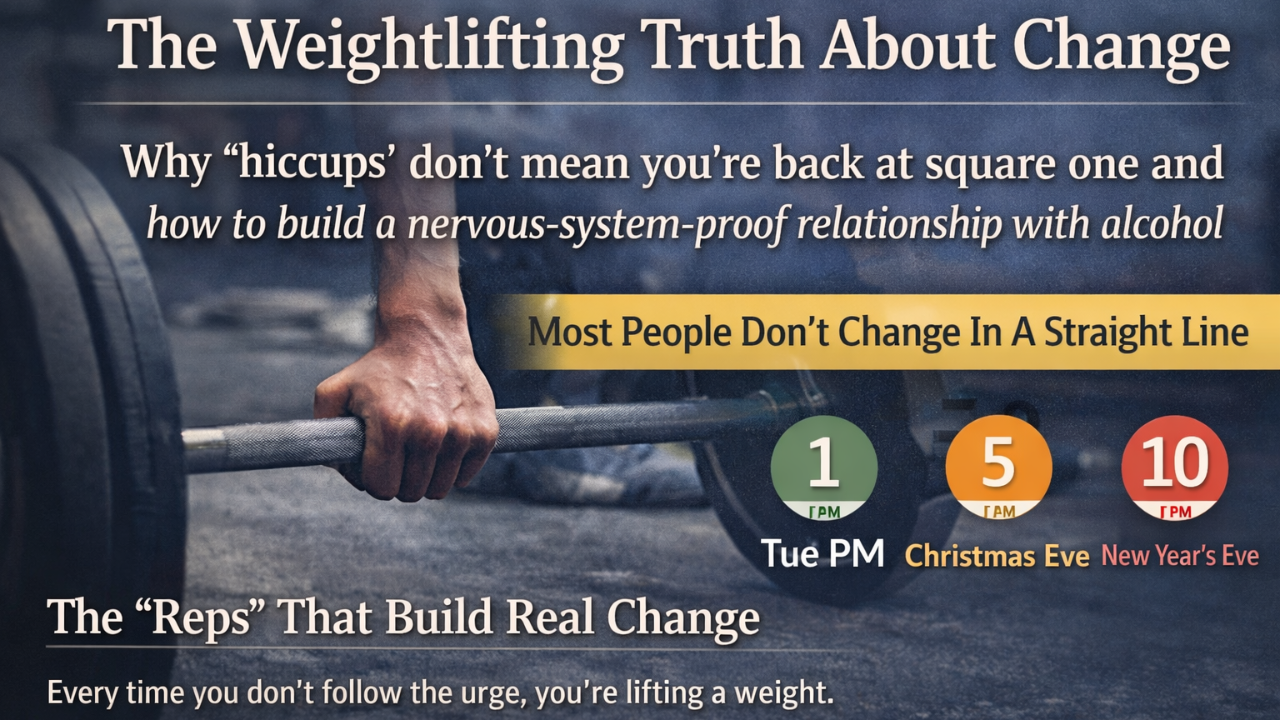
The Weightlifting Truth About Change
Why “hiccups” don’t mean you’re back at square one and how to build a nervous-system-proof relationship with alcohol
At the start of a recent community call, we had the usual New Year chaos: tech glitches, hot weather chat, travel stories, and laughter. And then we landed somewhere real.
Because this time of year has a way of doing that.
It’s loud, full, social, overstimulating. It pulls on memory, identity, tradition, grief, fatigue, and the “just one won’t matter” storyline all at once. And if you’re changing your relationship with alcohol, the festive season can feel like doing a deadlift on a moving bus.
Here’s the truth I want to normalise
Most people don’t change in a straight line.
Some of us have been “on the journey” for years. Some for months. Some for decades. And even for the most capable, high-functioning, self-aware people, alcohol can remain the old automatic solution when life turns up the heat.
That does not mean you’re failing.
It means you’re human, and you’re rewiring.
The “Reps” That Build Real Change
One of the most helpful metaphors that came up in the call was this:
Every time you don’t follow the urge, you’re lifting a weight.
And the context determines how heavy that weight is.
A random Tuesday night urge is a lighter weight.
Christmas Eve with family and a fridge full of wine is heavier.
New Year’s Eve with fireworks and champagne energy is heavier still.
And then there are the unexpected weights: grief, shock, exhaustion, conflict, loneliness, a life event you didn’t train for.
These are the moments where people often say, “It snuck up on me.”
It didn’t come out of nowhere.
It came out of your nervous system doing what it has practised for years: seeking relief.
So the goal isn’t “be strong forever.”
The goal is: build capacity through repetition.
Not perfection.
Repetition.
Why “Just One” Can Turn Into “Game Over”
Someone shared something many of you will recognise:
“I was confident through Christmas… and then late in the evening something happened and I drank. I hadn’t planned it. I was ashamed.”
This is the part most people misunderstand about alcohol and the brain:
Once the pattern is established, the first drink is not “one drink.”
It’s a switch.
Even if moderation works for a short period, the brain keeps alcohol “in play.”
It stays on the mental whiteboard. It remains a negotiation.
And negotiations are exhausting.
That’s why some people can do “one or two” for a few weeks, even a few months… and then find themselves back in the same place.
It’s not lack of discipline.
It’s learned neurochemistry plus an old pathway that lights up fast when ethanol arrives.
The Most Important Data Is the Day After
This might be the most uncomfortable part of the whole conversation, and also the most powerful.
When someone slips, the instinct is to move on quickly.
To avoid the shame. To push past the disappointment. To “not dwell.”
But here’s the problem:
If you don’t fully take in the cost, your brain will keep remembering the highlight reel.
It will remember the relief.
It will forget the heaviness.
So we talked about doing something counter-cultural:
Make the “day after” data unforgettable (without beating yourself up)
Not intellectually. Somatically.
-
How did it feel in your body?
-
What did it do to your mood?
-
What did it do to your self-trust?
-
What did it do to your energy, your patience, your confidence?
This isn’t punishment.
It’s learning.
Because when the brain consistently links alcohol with pain, not payoff, it stops romanticising it. Over time, the urge loses its sparkle.
You start to see the whole movie, not just the trailer.
Co-Regulation: The Missing Ingredient Most People Don’t Talk About
A theme that kept weaving through the call was support.
Not “tips.” Not “motivation.”
Regulation.
People repeatedly said they felt calmer after a short breakout conversation. That is not coincidence. That’s physiology.
Your nervous system changes in the presence of safe people.
This is why isolation is such a risk factor for relapse.
And why reaching out is not weakness. It’s strategy.
Sometimes the most effective tool isn’t a journal prompt or a breathing exercise.
Sometimes it’s a voice note to someone who gets it that simply says:
“I’m feeling activated. I’m craving relief. I need steadiness.”
That one sentence can interrupt a spiral.
The Two-Part Identity Shift That Creates Momentum
We did a simple values-based reflection using the “C” qualities many of you know well: confidence, courage, calm, compassion, connection, congruence (and more).
People shared wins like:
-
First alcohol-free Christmas (in a wine-heavy family home)
-
First alcohol-free New Year’s Eve, using an exit strategy and finding fun elsewhere
-
Increased calm, reduced brain fog, better sleep, weight loss, clearer decisions
-
A deeper sense of “I’m a non-drinker” rather than “I’m resisting drinking”
And also the growth edges:
-
Control before the first drink
-
Staying present instead of future-tripping
-
Re-engaging in relationships with compassion (after a season of focusing inward)
-
Congruence: aligning daily actions with the identity you’re building
Here’s the takeaway:
Confidence grows from evidence
Evidence grows from reps
Reps grow from small, repeated decisions
Not grand declarations.
Small decisions, stacked.
Practical Tools: “Prepared Beats Powerful”
A few simple strategies came through strongly:
1) Pre-decide your drink
If there’s even a chance you’ll be in a “nothing but wine and beer” environment, plan ahead.
-
Bring your own option
-
Call ahead
-
Have a default order (sparkling water with lime, AF beer, kombucha, tonic with citrus)
2) Have an exit plan
Not dramatic. Not apologetic.
Just: “I’ve got an early start.”
Or: “I’m heading off while I’m still feeling good.”
3) Change the environment, change the outcome
One person stepped away from the party intensity and went to a silent disco instead.
It wasn’t about “avoiding.”
It was about choosing a different nervous-system experience.
4) When the urge hits, translate it
Instead of “I need a drink,” try:
“My system is asking for down-regulation.”
Then meet the need directly:
-
food
-
water
-
movement
-
connection
-
breath
-
sleep
-
solitude
You’re not fighting a craving.
You’re responding to a need with leadership.
The Bigger Invitation: A Year of Looking In
Toward the end of the call, we touched something deeper than drinking:
Most people spend their lives looking out.
Looking at others. Looking at the future. Looking for certainty.
Or looking back with regret.
But real transformation asks for a quieter practice:
What if you gave yourself a year of prioritising your inner world?
Your mental health. Your regulation. Your values. Your growth.
Not as a selfish retreat.
As the most impactful investment you could make.
Because when your internal state becomes steady, your external life starts to reorganise itself around that steadiness.
You don’t need to prove as much.
You don’t need to defend as much.
You don’t need to escape as much.
You become congruent.
And that changes everything.
If you want to turn this into your “January reset”
Try this simple 7-day experiment:
Daily
-
60 seconds of regulation (slow exhales, a short walk, cold water on wrists, legs-up-wall)
-
one micro-recovery between tasks (no phone, just breathing or sunlight)
Twice
-
co-regulate intentionally (call, voice note, walk with someone safe)
Once
-
practise a known trigger with preparation + exit plan
End of week
-
write: “Where did I choose alignment over autopilot?”
No drama. Just data.
Closing thought
The people who create lasting change aren’t the ones who never wobble.
They’re the ones who return quickly.
They don’t disappear for six months.
They don’t turn a slip into a story about who they are.
They get back to the next decision.
That’s the work.
That’s the win.


