If you have ever been told you are too sensitive, you feel things too deeply, or you just need to toughen up, this post is for you.
The Orchid Theory, developed by Professor Tom Boyce and Professor Bruce Ellis, offers a completely different framework for understanding sensitivity. And for many people, particularly those who have quietly struggled to fit into a world that does not seem built for them, it changes everything.
What Is a Highly Sensitive Person?
The concept of the Highly Sensitive Person, or HSP, was first identified by psychologist Dr Elaine Aron in the early 1990s. Her research found that HSPs make up around 20 percent of the population, and that this trait exists across more than 100 animal species, suggesting it is not a flaw but a biological variation that has persisted for good reason.
Dr Aron identified four core characteristics that define the HSP experience:
Depth of processing. HSPs think about things more deeply and search for meaning in relationships, work, and life in general. Superficial conversation can feel genuinely uncomfortable, and they often need time alone to process what they have taken in.
Overstimulation. HSPs are easily overwhelmed by busy environments, noise, and the pace of modern life. They typically need regular rest and solitude to recover from overstimulation in a way that non-HSPs simply do not.
Emotional responsiveness. HSPs have heightened reactions to their own emotions and to the emotions of the people around them. At the far end of this scale is the HSP empath, someone who experiences other people’s feelings almost as if they were their own.
Sensitivity to subtlety. HSPs pick up on details that most people miss, from changes in tone and facial expression to the general atmosphere in a room, often before they are consciously aware they have noticed anything at all.
Brain research supports these findings. Studies show that the amygdala, the part of the brain responsible for the stress response, is larger and more active in HSPs, meaning a higher baseline reaction to perceived threats. Research also shows greater activity in the insula, the part of the brain where inner states, emotions, and outer experiences are integrated into conscious awareness.
In simple terms, HSPs are more deeply aware of both their inner world and the world around them. In a society designed for and by the other 80 percent of the population, this can feel like a significant disadvantage. And for many HSPs, it creates a constant, exhausting pressure to be different from how they naturally are.
What Is the Orchid Theory?
Professor Tom Boyce, a researcher in paediatrics and psychiatry at the University of California, proposed the Orchid Theory to explain why certain people are more sensitive to their environment than others. He described it this way:
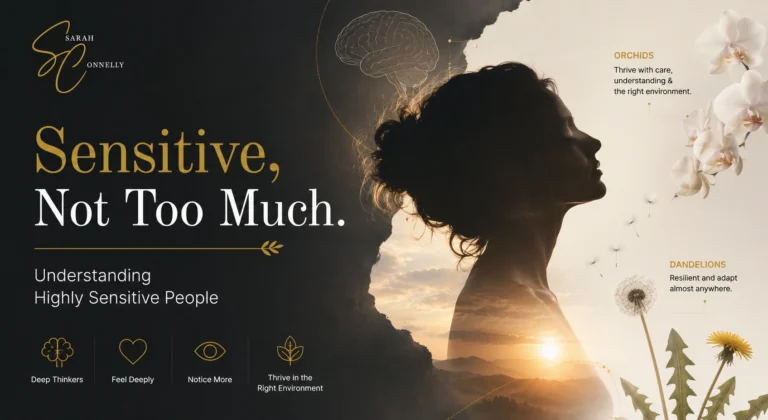
“These dandelion children — equivalent to our normal or healthy children, with resilient genes — do pretty well almost anywhere, whether raised in the equivalent of a sidewalk crack or a well-tended garden. Ellis and Boyce offer that there are also orchid children, who will wilt if ignored or maltreated but bloom spectacularly with greenhouse care.”
Tom Boyce, “Biological Sensitivity to Context”
The theory centres on what Boyce called risk genes: genetic variants that increase a person’s susceptibility to mental health challenges including anxiety, depression, ADHD, and addiction. Crucially, carrying these genes does not automatically lead to these difficulties. What matters enormously is the environment.
Dandelion people are resilient and do reasonably well in almost any conditions. Orchid people are far more sensitive to their surroundings. In difficult or unsupportive environments they struggle significantly. But in the right environment, with genuine care, structure, and nurturing, they do not just survive. They flourish in ways that dandelion people simply cannot.
The research shows that people with these sensitive genes, when given a supportive environment, demonstrate greater capacity for creativity, empathy, compassion, and depth of experience than their less sensitive peers. The very trait that creates the vulnerability is the same one that enables the extraordinary.
Why HSPs Often Turn to Substances
My working theory, shaped by years of coaching and my own experience, is that HSPs are the orchid people. And in a world designed for dandelions, the mismatch is painful.
In my own life, being an HSP combined with a difficult early childhood meant I lived in a near-constant state of anxiety. For years I believed everyone felt the way I did, and I judged myself harshly for struggling with things that others seemed to handle with ease.
Alcohol provided relief from that. Quickly, reliably, and with very little effort. For a nervous system that was working overtime just to get through a normal day, it was extraordinarily effective at turning the volume down.
What I did not understand then was that HSPs experience a significantly greater sense of reward from substances than non-HSPs. The relief is not just psychological. It is biological. Which is also why moderation rarely works for HSPs. We tend to feel things fully or not at all. There is very little middle ground.
Since removing alcohol and learning about this trait, I have come to understand that my reliance on it had a great deal to do with trying to be something I was not. I was trying to be a dandelion in a world that did not have much room for orchids.
What This Means in Practice
Knowing whether you are an orchid or a dandelion is not about having an excuse or a label. It is about understanding the conditions you actually need to function well, and giving yourself permission to create them rather than continuing to judge yourself for needing them.
For HSPs, that means recognising that certain environments are genuinely more costly for you than for others. That needing more recovery time is not laziness. That feeling things deeply is not weakness. And that the sensitivity you have spent years trying to manage or numb is not the problem. It is a biological trait that, in the right environment, becomes one of your greatest strengths.
Throughout history, highly sensitive people have served as thought leaders, artists, advisors, and moral guides. The depth of processing, the emotional attunement, the ability to notice what others miss: these qualities are not liabilities. They are capabilities.
The orchid, given the right conditions, does not just survive. It blooms beyond what anyone expected.
If you see yourself in any of this, understanding the connection between high sensitivity and alcohol is a useful next step. And if you are ready to explore what support looks like, find out more about working with Sarah Connelly.