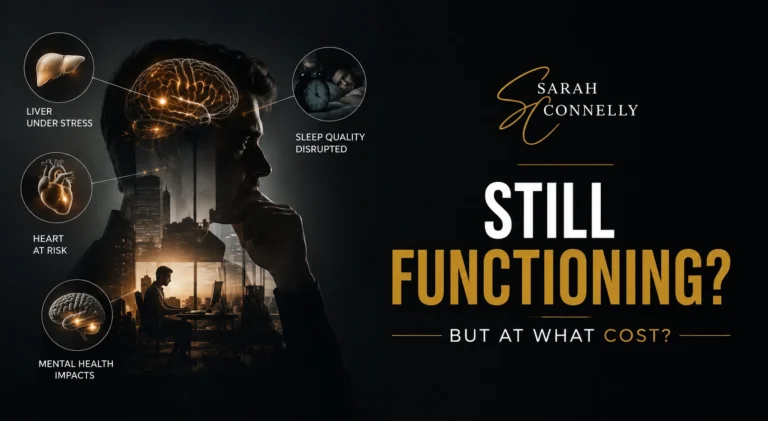
Functioning well is not the same as being unaffected. Alcohol causes measurable harm to your liver, heart, brain, sleep, and mental health well before your performance or daily life shows visible signs of disruption. For high-achieving professionals, that gap between feeling fine and being fine is exactly where the problem lives.
Functioning Isn’t the Same as Fine
Most professionals I work with are not in crisis. They are running businesses, leading teams, and showing up every day. Alcohol fits quietly into that life, and because nothing has visibly broken down, the harm stays hidden. You feel in control. You are meeting your targets. From the outside, everything looks fine.
The problem is your body does not measure harm by how your life looks. Your liver begins accumulating fat well before you notice any symptoms. Your blood pressure climbs without announcing itself. Your sleep architecture shifts even when you feel like you slept. Your brain chemistry adjusts around alcohol in ways so gradual you attribute the changes to stress, age, or a heavy workload.
By the time anything becomes visible, the pattern has usually been running quietly for years. Functioning well was never evidence the drinking was not a problem. It was just evidence the problem had not surfaced yet.
What Alcohol Is Doing to Your Body Right Now
Liver
Your liver processes approximately 90% of the alcohol you consume. It can handle roughly one standard drink per hour. When you drink beyond that rate regularly, fat begins to accumulate in liver cells, a condition called alcoholic fatty liver disease.
According to the National Institute on Alcohol Abuse and Alcoholism (NIAAA), fatty liver disease develops in up to 90% of people who drink heavily, and it produces no symptoms in its early stages. You feel fine. Your liver does not.
Early-stage fatty liver is reversible. The longer the pattern continues without change, the higher the risk of progression to inflammation and, over time, scarring.
Heart
Regular alcohol consumption raises blood pressure, increases triglyceride levels, and contributes to irregular heart rhythms. The Mayo Clinic confirms that heavy drinking is one of the leading preventable causes of cardiomyopathy, a condition where the heart muscle weakens and struggles to pump blood effectively.
For professionals managing high-stress workloads, where cardiovascular risk is already elevated by cortisol and poor sleep, adding alcohol compounds that risk in a way that does not announce itself until something goes wrong.
Cancer Risk
The World Health Organization classifies alcohol as a Group 1 carcinogen, the highest risk category. Alcohol is directly linked to cancers of the mouth, throat, esophagus, liver, colon, and breast.
A 2025 Stanford Medicine analysis confirmed that even low-level drinking can contribute to cancer risk through acetaldehyde, a toxic byproduct produced when the liver breaks down alcohol. Acetaldehyde damages DNA in cells throughout the body, and the risk is not limited to people who drink heavily.
What Alcohol Is Doing to Your Mental Health
Anxiety
Alcohol is a depressant that initially suppresses the amygdala, producing a calming effect. As it clears the system, the amygdala rebounds to a heightened state, producing anxiety that is often higher than the baseline before drinking.
For professionals who drink to manage stress, the result is a cycle where alcohol creates the very anxiety it appears to relieve. A 2025 analysis from Stanford Medicine noted that even low-level drinking can worsen anxiety and depression, particularly in people who use alcohol to cope emotionally.
Sleep
Alcohol disrupts REM sleep, the stage responsible for emotional processing and memory consolidation. Even if you sleep for seven or eight hours after drinking, the quality of that sleep is measurably lower. The next day’s cognitive performance, emotional regulation, and stress tolerance all pay the cost.
For a professional operating at a high level, impaired sleep is not a minor inconvenience. It compounds across the week and erodes the mental edge that performance depends on.
Mood and Motivation
Regular drinking progressively lowers dopamine baseline. Your brain’s natural reward system becomes less responsive to everyday sources of satisfaction, including achievement, connection, and creative work. Things that used to feel rewarding feel flat. The drink becomes the primary source of relief, not because it works well, but because nothing else feels like it works at all.
Why “Grey Area Drinking” Is the Category Most Professionals Miss
Most alcohol health messaging is calibrated for clinical dependence. It talks about rock bottom, loss of control, and addiction. If none of that applies to you, it is easy to conclude you are fine.
But there is a large space between casual drinking and dependence where real harm is already accumulating. Understanding what it means to be a grey area drinker is important because most of the health risks covered in this blog apply fully within that space, not just at clinical levels.
You do not need to be dependent for alcohol to be affecting your liver, your heart, your sleep, and your mental health. You just need to be drinking regularly.
Why Moderation Does Not Solve the Problem for Most People
The instinct when confronted with these risks is to moderate. Drink less, have rules, keep it under control.
The problem is that moderation requires ongoing mental effort, creates a constant internal negotiation, and for many professionals, simply does not hold. The reason is neurological, not motivational. Once alcohol has established itself as the brain’s primary stress response tool, trying to moderate it is like trying to use a broken thermostat to regulate temperature. The mechanism itself is the problem.
Why moderation does not work for many drinkers comes down to how the brain’s reward and habit systems interact with alcohol specifically, and why willpower alone is rarely enough to override them.
The Hidden Costs That Do Not Show Up on a Blood Test
Functioning well professionally can mask costs that accumulate in other areas:
Relationships where you are physically present but mentally elsewhere. Creative and strategic thinking that operates slightly below its actual capacity. Recovery from stress that takes longer than it should. A quiet background tension between who you are and who you intended to be.
None of these show up in a performance review. All of them are real, and all of them are connected to regular drinking in ways that become clearer only when the drinking stops.
Frequently Asked Questions
Why is alcohol bad for you even in moderate amounts? Alcohol is a Group 1 carcinogen. No amount has been confirmed as risk-free by the World Health Organization. Even moderate drinking is associated with elevated cancer risk, raised blood pressure, disrupted sleep, and increased anxiety over time.
Can alcohol affect your health if you are not addicted? Yes. Liver stress, cardiovascular strain, sleep disruption, and anxiety all develop across the drinking spectrum, not only at clinical dependence levels. You do not need to meet a diagnostic threshold for alcohol to be affecting your health.
What does alcohol do to your body over time? Regular drinking can lead to fatty liver disease, elevated cardiovascular risk, hormonal disruption, reduced sleep quality, lowered dopamine baseline, and increased cancer risk. Most of these develop gradually with no obvious symptoms in the early stages.
What are the short-term effects of alcohol on a functioning professional? Alcohol disrupts REM sleep, raises next-day anxiety, reduces prefrontal cortex function during intoxication, and lowers dopamine baseline with repeated use. Over the course of a working week, those effects compound in ways that are easy to attribute to stress or workload rather than to drinking.
Why is alcohol so bad for sleep, even when it helps you fall asleep? Alcohol sedates you but suppresses REM sleep throughout the night. Sleep duration may look normal while sleep quality is significantly impaired. The cognitive and emotional cost of that shows up the next day and accumulates across the week.
Take the First Step Toward an Alcohol-Free Life
If you are a professional who drinks regularly, feels in control, and has never had a rock-bottom moment, you are likely in the grey area. The cost is not always visible. But it is real, and it is accumulating.
Sarah Connelly works with professionals across Australia and internationally to help them reset their relationship with alcohol using a science-based, shame-free approach. No labels. No rehab. Just a structured path forward built for people who are still functioning but know something needs to change.