I used to believe I could not live without alcohol. Not in the sense that I was physically dependent on it, but it was woven into every part of my world. My partner drinks, my friends drink, my wider family drinks. Every occasion I attended involved alcohol. How could I possibly live in the world I had built without it? I believed it was not possible.
When I dug a little deeper, I found other beliefs lurking underneath. I was afraid that if I conquered the drinking, bad things would happen. That I would lose my marriage, my friends, and my ability to have fun. I was afraid of what I would do instead. Afraid of the potential I had quietly kept bottled up inside me. Afraid of taking full ownership of my life.
During my drinking years I would often tell myself that alcohol was holding me back, keeping me from living up to what I was capable of. And underneath that was a terrifying thought. What if I removed the one thing I had blamed for my limitations and discovered there was nothing particularly special waiting on the other side?
On reflection, it was not quitting alcohol I was afraid of. I was afraid of myself. If alcohol was not the problem, I was the only thing left. And that meant taking full responsibility for my life and my choices. I was not ready for that for a very long time.
How Beliefs Keep Us Stuck
Our beliefs shape our experience of reality. When we treat a thought as an absolute truth rather than just a thought, it starts to run our behaviour. We stop questioning it. We stop testing it. We just live inside it.
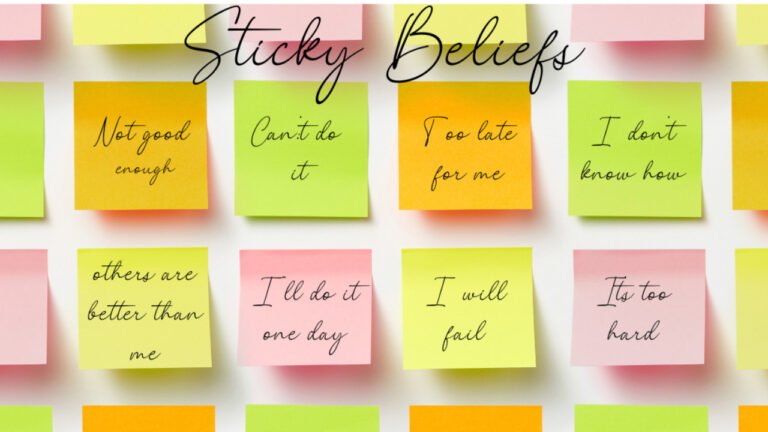
These are what I call sticky beliefs. Deeply ingrained ideas we have formed about ourselves, others, and the world, and they have a way of keeping us trapped in cycles of doubt, fear, and patterns we cannot seem to break.
Common ones include: I am not as good as other people. This is not going to work. There is something wrong with me. I will always be this way. Everyone else seems so much stronger than me.
When we hold these thoughts as truths, they create a real physical response. A tight chest, a sinking feeling, a rush of anxiety. And before we know it, we are reaching for the familiar way of coping with that discomfort. The belief feels even more real. The cycle continues.
For many years I stayed stuck in exactly this way. One day never came. And when it finally did, I allowed my old beliefs to pull me back, time after time. I was impatient, my expectations were too high, and after a few months I would resign myself to needing alcohol as the excuse for not yet becoming who I wanted to be.
You Are Not Your Thoughts
The good news is that we are not our thoughts. If we were our thoughts, we would not be able to notice them. They are separate from us, like clouds passing through a sky. We can see them without being them.
That small distinction creates space. And in that space, we can choose differently.
The first step is simply noticing when a sticky belief appears. Naming it. Saying to yourself, there is that thought again that I am not good enough. Just naming it separates you from it slightly.
The next step is questioning whether it is actually true. Do you have real evidence for it, or is it just a familiar mental loop that has never been tested?
From there, try shifting the question. Instead of asking what if this all goes wrong, ask what if it actually works? What if change is genuinely possible for me?
And then, most importantly, take action. This is the part that most people skip. Simply choosing a more positive belief is not enough. The mind needs new evidence before it will accept a new belief as true. Action is the only thing that creates that evidence. Awareness and action together are the real combination.
As an example, I told myself for years that I could quit drinking whenever I wanted. That belief kept me safe without requiring me to actually prove it. Some people live inside that belief for a lifetime without ever testing whether it is true.
If you are worried you cannot do something, telling yourself you can without taking action will not change the underlying belief. Only doing it will.
A Lifelong Practice
This is not about eliminating every negative thought. They will still appear, especially in the early stages of change. But when we stop treating them as facts, we reclaim something important. We step out of old patterns. We choose growth over staying stuck.
Take a few moments and write down some of your own sticky beliefs around alcohol. Just seeing them on paper can create enough distance to start questioning them.
Ask yourself whether the thought is serving you, holding you back, or keeping you safe in a way that is no longer useful. Ask what you are afraid would happen if you let it go. Ask whether you can face that fear.
Awareness is the first step. Action is what makes the new belief real.
Here is a real example of how beliefs can shift through consistent, honest action.
| Old Belief | New Belief |
|---|---|
| I can quit whenever I want | I can quit, I have quit, I can do this |
| I do not have a big enough problem | The problem was big enough for me to choose change |
| I will be judged and isolated | I care more about my own self-respect than others’ opinions |
| I will fail and feel even worse | I commit to trying and feel more confident every day |
| I cannot enjoy life without alcohol | I enjoy life more than I ever did when I was drinking |
| I cannot do it | I will always find a way |
I am not here to tell you it is easy. But I can tell you it is possible if you want it enough.
If you want to understand more about the inner conflict that comes from living against your own values, why we feel an inner conflict about drinking is worth reading alongside this. And when you are ready to work through these beliefs with support, find out more about working with Sarah Connelly.
With love, Sarah