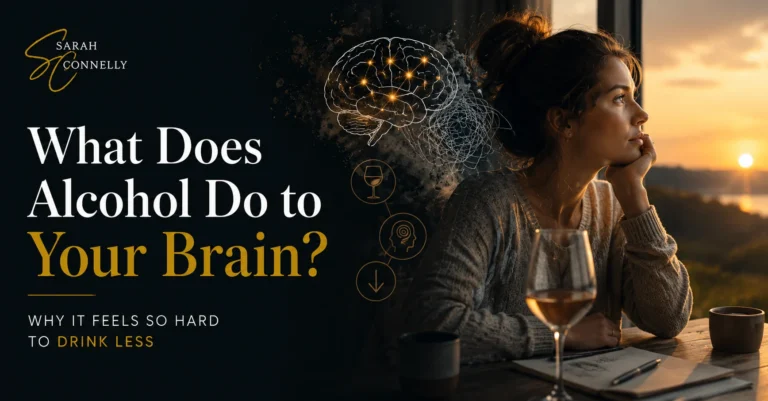
Most professionals who drink regularly still show up, perform, and function. But underneath that, alcohol is reshaping how your brain handles stress, reward, and decision-making with every drink. It boosts GABA, suppresses glutamate, and trains your dopamine system to depend on it. The science is clear, and it starts from the very first sip.
What Happens in Your Brain the Moment You Drink
Alcohol reaches your brain within minutes of your first drink. Once there, it does two things simultaneously. It boosts gamma-aminobutyric acid (GABA), your brain’s primary calming neurotransmitter, and it suppresses glutamate, which drives alertness and mental activity. The result is the familiar sense of relaxation, reduced anxiety, and lowered inhibition that most people associate with a drink after work.
Your brain’s reward pathway also responds immediately. Alcohol triggers a dopamine release in the nucleus accumbens, the area responsible for pleasure and motivation. Your brain registers alcohol as a reward and begins building an association between drinking and feeling better.
Over time, your brain stops producing dopamine as readily on its own. You need alcohol to feel what used to come naturally.
How Does Alcohol Affect the Brain Scientifically?
Alcohol acts on several distinct brain regions, each with a different function.
The prefrontal cortex handles decision-making, impulse control, and rational thinking. Alcohol slows activity here, which is why your judgment shifts after a few drinks and why the version of you at 10pm makes decisions the version of you at 7am regrets.
The hippocampus is responsible for forming new memories. Alcohol disrupts communication between neurons in this region, which is why heavy drinking causes blackouts. The hippocampus cannot encode what happened because the communication pathway was chemically blocked.
The cerebellum controls coordination and balance. Alcohol slows cerebellar function, producing the physical signs of intoxication: slower reactions, impaired coordination, and altered speech.
The amygdala regulates emotional responses, particularly fear and stress. Alcohol initially suppresses amygdala activity, which creates the calming effect. As alcohol clears the system, the amygdala rebounds, which is why anxiety tends to spike the morning after drinking.
What Does Alcohol Do to Your Brain Cells Over Time?
Alcohol does not kill brain cells in the dramatic way the phrase implies. What it does is damage the dendrites, the branch-like extensions on neurons that allow brain cells to communicate with each other.
Chronic drinking also reduces the production of new neurons in the hippocampus, a process called neurogenesis. The brain becomes less capable of forming new connections and adapting to new information.
Research published by the National Institute on Alcohol Abuse and Alcoholism confirms that chronic heavy drinking can shrink brain tissue, particularly in the frontal lobes and cerebellum. Frontal lobe shrinkage affects planning, decision-making, emotional regulation, and the ability to assess risk accurately.
For a high-achieving professional, these are not abstract concerns. They show up as slower thinking under pressure, reduced emotional regulation in high-stakes situations, and a creeping difficulty concentrating that gets explained away as stress or age.
Why High-Achieving Professionals Are Particularly Vulnerable
Alcohol and professional stress interact in a specific and compounding way. Chronic work stress elevates cortisol, your body’s primary stress hormone. Elevated cortisol depletes dopamine over time, leaving you in a low-reward state where nothing feels particularly satisfying. Alcohol temporarily restores that dopamine signal, which is why the drink at the end of a demanding day feels so necessary.
The problem is that alcohol also raises cortisol during withdrawal. So the next morning, your baseline stress level is higher than it was the day before. You drink again to bring it down. The cycle becomes self-reinforcing without any conscious decision to make it so.
Executives, lawyers, and healthcare professionals are not drinking because they are weak. They are drinking because their neurochemistry has been shaped by sustained high-stress environments in a way that makes alcohol feel functional. It was never a character flaw. It was always brain chemistry.
How Does Alcohol Affect the Brain Long-Term?
The long-term picture depends on frequency, quantity, and how early the pattern started.
What the research shows consistently is that regular drinking, even without clinical dependence, produces measurable changes in brain structure and function. A study from University College London found that people who drank above low-risk guidelines showed faster cognitive decline over time compared to those who did not.
Alcohol brain damage symptoms in grey area drinkers are often subtle: reduced working memory, difficulty with complex problem-solving, lower stress tolerance, and impaired sleep quality that compounds cognitive load over time. The good news is that the brain retains significant capacity for recovery, particularly for people who are not at the clinical dependence end of the spectrum.
Brain Recovery Timeline After Quitting Alcohol
The brain begins to recover within days of stopping drinking.
Days 1 to 7: GABA and glutamate systems begin to rebalance. Sleep is often disrupted initially as the brain adjusts to functioning without alcohol’s sedative effect.
Weeks 2 to 4: Dopamine regulation starts to stabilise. Many people notice improved mood, mental clarity, and reduced anxiety during this window.
Months 1 to 3: Prefrontal cortex function improves noticeably. Decision-making, emotional regulation, and concentration sharpen. Cognitive performance tends to improve measurably in this period.
Months 3 to 6: Neuroplasticity increases. The brain becomes more capable of forming new connections. Most grey area drinkers report this as the period where they feel genuinely different, not just sober.
For a deeper look at the physical side of recovery, the blog on how alcohol affects the brain, body, and mental health covers what happens across multiple body systems when drinking stops.
Frequently Asked Questions
Does drinking alcohol every day change your brain permanently? Alcohol boosts GABA and suppresses glutamate, creating sedation and reduced inhibition. It also triggers dopamine release in the brain’s reward pathway. Over time, regular drinking alters neurotransmitter levels and affects the prefrontal cortex, hippocampus, and cerebellum.
What is the 2 2 3 rule for alcohol? The 2 2 3 rule is an informal drinking guideline suggesting no more than 2 drinks per sitting, no more than 2 days per week, and at least 3 alcohol-free days. It is not a clinical standard but is used as a general moderation reference.
Does drinking alcohol affect GLP-1? GLP-1 (glucagon-like peptide-1) is a hormone involved in blood sugar regulation and appetite. Early research suggests alcohol may suppress GLP-1 secretion, which can affect appetite regulation and blood sugar response. If you are taking a GLP-1 medication, speak with your doctor about alcohol interactions specifically.
Does drinking alcohol affect finasteride? No direct pharmacokinetic interaction between alcohol and finasteride has been established in clinical literature. Both can affect the liver over time and mood in some individuals. If you are taking finasteride and drinking regularly, discuss the combination with your prescribing doctor.
How does alcohol affect the brain the next day? As alcohol clears your system, the amygdala rebounds from its suppressed state, producing elevated anxiety and heightened stress sensitivity. Cortisol is also higher in withdrawal. Sleep quality is typically poor even if sleep duration feels normal, because alcohol suppresses REM sleep throughout the night.
What happens when you drink alcohol every day? Daily drinking accelerates tolerance, meaning you need more alcohol to achieve the same effect. It disrupts dopamine regulation, elevates baseline cortisol, impairs sleep architecture, and over time reduces prefrontal cortex function. The brain essentially recalibrates around the presence of alcohol and struggles to regulate mood and stress without it.
Understanding the brain chemistry behind alcohol cravings can also help explain why daily drinking becomes difficult to stop, even when you want to.
Ready to Reset Your Relationship with Alcohol?
If you recognise your drinking pattern in what you have read here, you are not alone and you are not without options. Sarah Connelly works with high-achieving professionals across Australia and internationally who want to change their relationship with alcohol without labels, rehab, or shame. Explore Sarah Connelly’s programmes and find out what a science-based reset looks like for someone at your level.